

The Phantom Partner
Have you ever sat across from the person you love and felt completely invisible? You're right there in the room, showing up with an open heart, but every word you say gets twisted. It feels like they're arguing with someone else entirely. It's a lonely, heavy feeling, and it leaves you wondering how a good relationship can suddenly feel so complicated.
This happens because people carry old hurts into new rooms. When someone has unhealed pain from their past, they don't always see the person actually in front of them. Instead, they respond to a composite figure built from everyone who ever hurt them; an ex who cheated, a parent who left, or a friend who betrayed them. This composite gets projected onto the current partner. The real partner, who could be completely loyal, present, and loving, becomes invisible behind this ghost. We call this the Phantom Partner.
The dangerous part is that the Phantom Partner looks exactly like you, acts like you, and speaks in your voice. But it isn't you. It's a bundle of old fears wearing your face, and it completely blocks your loved one from seeing the reality of who you're today. You're left trying to love someone through a layer of thick, distorted glass, where your actual behavior matters less than the historical shadow hanging over the table.
When the Phantom Partner takes over, logic completely leaves the room. You can have all the proof in the world that you're safe and faithful, but the evidence doesn't seem to matter. This is because you cannot argue someone out of a wound they don't even know they have. They genuinely believe they're reacting to what you just did, not what happened to them ten, twenty, or even forty years ago.
If you try to use facts to defend yourself, it usually just creates more friction. To their system, your defence looks like a coverup. The ghost tells them that people who have something to hide are the ones who argue the loudest. Your explanations get processed as defensiveness, and your desire to clear the air gets read as a sign of guilt.
It's a deeply frustrating cycle. You end up wasting all your energy trying to disprove a story that's not even about you, one that was written long before you ever met. You're treating the situation like a normal misunderstanding, but they're treating it like a real emergency. You can't use a logical map to navigate a storm that is entirely driven by ancient, emotional panic.

Living with this dynamic means entering a game where the rules change constantly, and the verdict is already written before the evidence comes in. Take a real example that happens all the time. A partner mentions that their person looked at another man. The person didn't actually look in that way; they were just observing the world the way they always have. But the old survival story is now running in the background.
Next time they go out together, the person consciously avoids looking at any man who could be perceived as a threat. They do this simply to protect their partner's feelings and keep the peace. But later that night, their partner messages them to say it's obvious they're trying not to look, which only proves they wanted to.
So now you find yourself in a position where looking was wrong, but not looking was also wrong, and there's no "correct" behaviour left for you to choose. When a relationship drops into this space, you're no longer dealing with reality. You're dealing with a pre-written script where you're guaranteed to lose no matter what you do, because the system has already decided that threat is inevitable.
When you can't win, your daily life begins to shrink. The real partner ends up constantly monitoring completely natural behaviour just to avoid triggering the ghost. You start watching where your eyes land when you walk into a coffee shop. You spend twenty minutes drafting a simple text message, rewriting every word so it can't be misread. You constantly check your own tone of voice to make sure it sounds soft enough.
This level of hypervigilance is completely exhausting. Ordinary existence becomes a minefield where a single misplaced glance or a delayed reply can set off an explosion. You stop acting naturally and start performing a role, trying to behave so perfectly that the fear won't wake up.
But you can't cure someone else's fear with your perfection. No matter how small you make yourself, the ghost will always find a way to break through the cracks. The tragedy is that while you're busy navigating their minefield, your own emotional needs are completely left by the wayside, buried under the pressure of trying to look flawless.
When couples hit this wall, they often think they just need better communication skills. They buy books, learn relationship tricks, and try to find better ways to phrase their thoughts. But this is not a communication problem. This is simply what it feels like to live inside someone else's fear.
No amount of clear talking can fix a situation where one person's nervous system cannot tell the difference between the phantom and the real human being in front of them. Their survival brain is running an old program that treats emotional closeness like a trap. When things go well, the alarm goes off, and the ghost appears to push you back to a safe distance.
Recognising this changes the whole battle. It allows the partner being projected onto to stop fixing the wrong thing. You can stop trying to change your wording or defend your actions, and finally see that the storm isn't actually about you. It's an internal blueprint running an automatic routine, and your words aren't the thing that can turn it off.
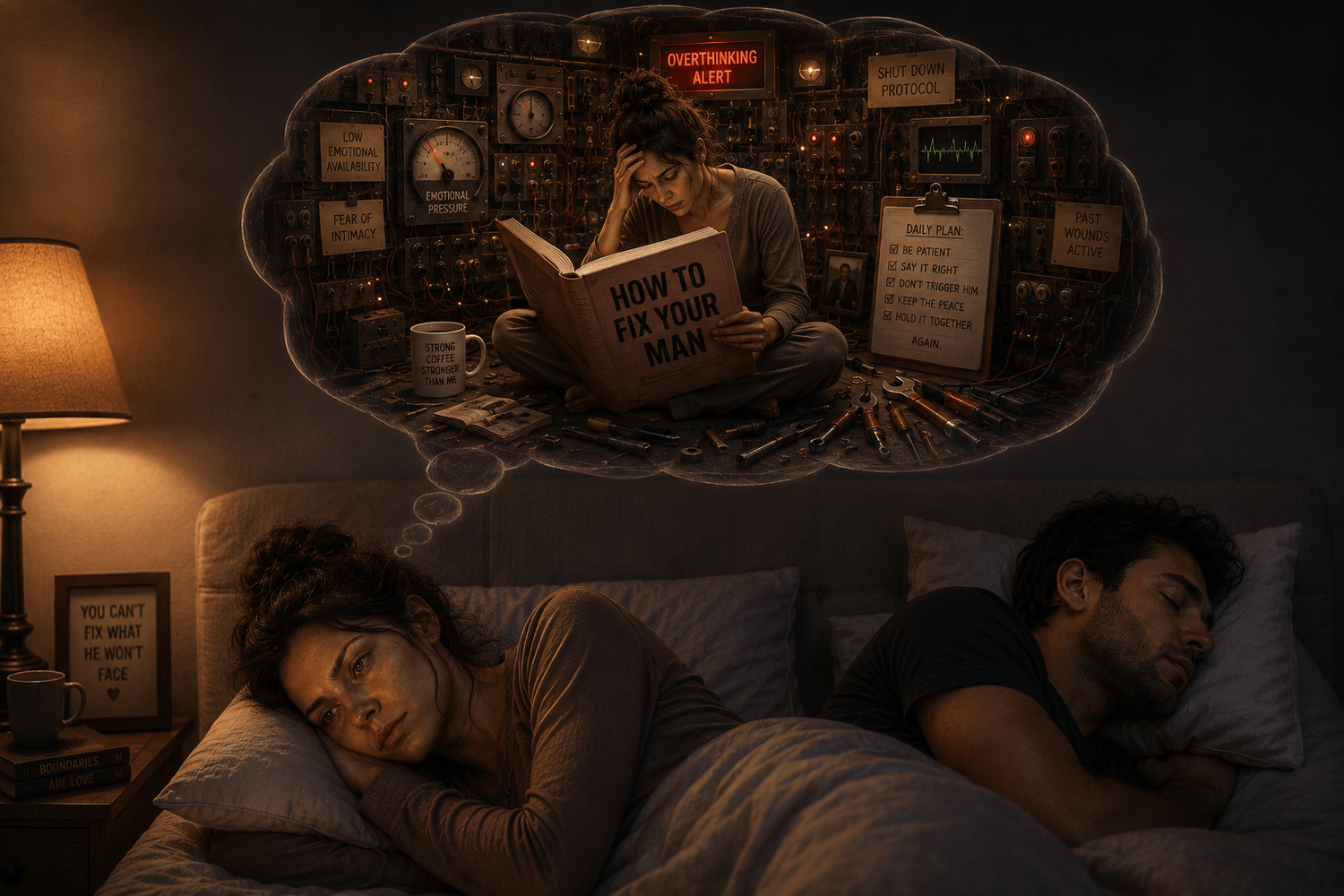
When you're the one constantly trying to outrun a ghost, you drop into a state of chronic over-functioning. You become the full-time manager of their emotional temperature, stepping in to soothe anxieties before they even happen. You sacrifice your own comfort, your own focus, and your own peace of mind just to prove that you are not the enemy they're running from.
This survival strategy works in the short term, but it comes at a massive personal cost. It drains your vitality and makes you a stranger to yourself. You spend so much time managing their historical alarms that you have no space left to process your own feelings, your own goals, or your own simple desires.
You're essentially running a marathon while carrying their past on your back. Real intimacy can't survive in an environment where one person is constantly working double-time just to keep the relationship baseline safe. True connection requires balance, and you cannot build a life when you're too tired to exist as yourself.
Your life becomes so much easier once you truly see that the phantom partner concept is not about blame. The person who's projecting the ghost onto you is not doing it consciously or maliciously. They love you, and they don't want to cause this pain. But their body genuinely cannot tell the difference between the past and the present.
To the primitive part of their brain, the fear feels like absolute fact. Their system is just using the old shield or the old sword to protect a soft, vulnerable inner world that was deeply broken once before. They're running an automatic survival routine to keep themselves from being destroyed again.
But understanding this pattern is the first step to stopping it. You cannot change a loop that you cannot see. Once both people can name the ghost in the room, the heavy layers of shame and blame can finally begin to drop away, allowing you to deal with what's actually real.
In this particular dynamic it's vital to see that neither person is the villain; they're both simply caught inside a painful story that was written long before their paths ever crossed. If you're the one being projected onto, remember that you have a right to be seen for who you actually are, and you can stop carrying the weight of crimes you never committed. If you're the one doing the projecting, have tenderness for your fear, but notice when you're treating a safe partner like an old enemy.
True peace arrives when we stop fighting the ghosts of yesterday and start choosing the truth of today.
Written by: Jodi ♡ The Attachment Code