

It's Not Neediness. It's Fear.
In the mainstream world of modern relationships, there's a word that gets thrown around with damaging frequency: needy. It's used to describe anyone who asks for reassurance, anyone who feels anxious when communication drops, or anyone who craves consistency and closeness. It's a label designed to sting, carrying a heavy weight of shame that implies a person's simply too much, too demanding, or emotionally weak.
From the outside, when someone's constantly checking their phone, asking if things are okay, or spiralling when a partner becomes quiet, it can look like an insatiable demand for attention. But this behavior isn't a character flaw, and it's not a sign of weakness. When you look beneath the frantic surface and ask what the nervous system's actually trying to protect, a completely different reality emerges.
It isn't neediness. It's a profound, terrifying experience of fear.
To understand why an anxious attachment system reacts so intensely, you have to understand what happens inside the body when a connection feels threatened. For someone with this pattern, a relationship isn't just a source of companionship; it's an emotional baseline for safety and stabilization. When that baseline shifts, even slightly, the internal alarm system triggers a full-blown survival response.
When a partner pulls away, goes quiet, or takes hours to respond to a text message, the anxious mind doesn't just think, oh, they must be busy. Instead, the nervous system interprets the sudden distance as an immediate drop in safety. It plunges into what's known as attachment panic.
Physically, this feels like an adrenaline spike. The heart rate increases, a tight knot forms in the chest, and the mind becomes entirely consumed by a single, desperate objective, which is to re-establish connection to regain safety. The constant texting, the searching for clues, and the urgent demands for reassurance aren't calculated behaviors; they're the frantic movements of a drowning person reaching for a lifeline.
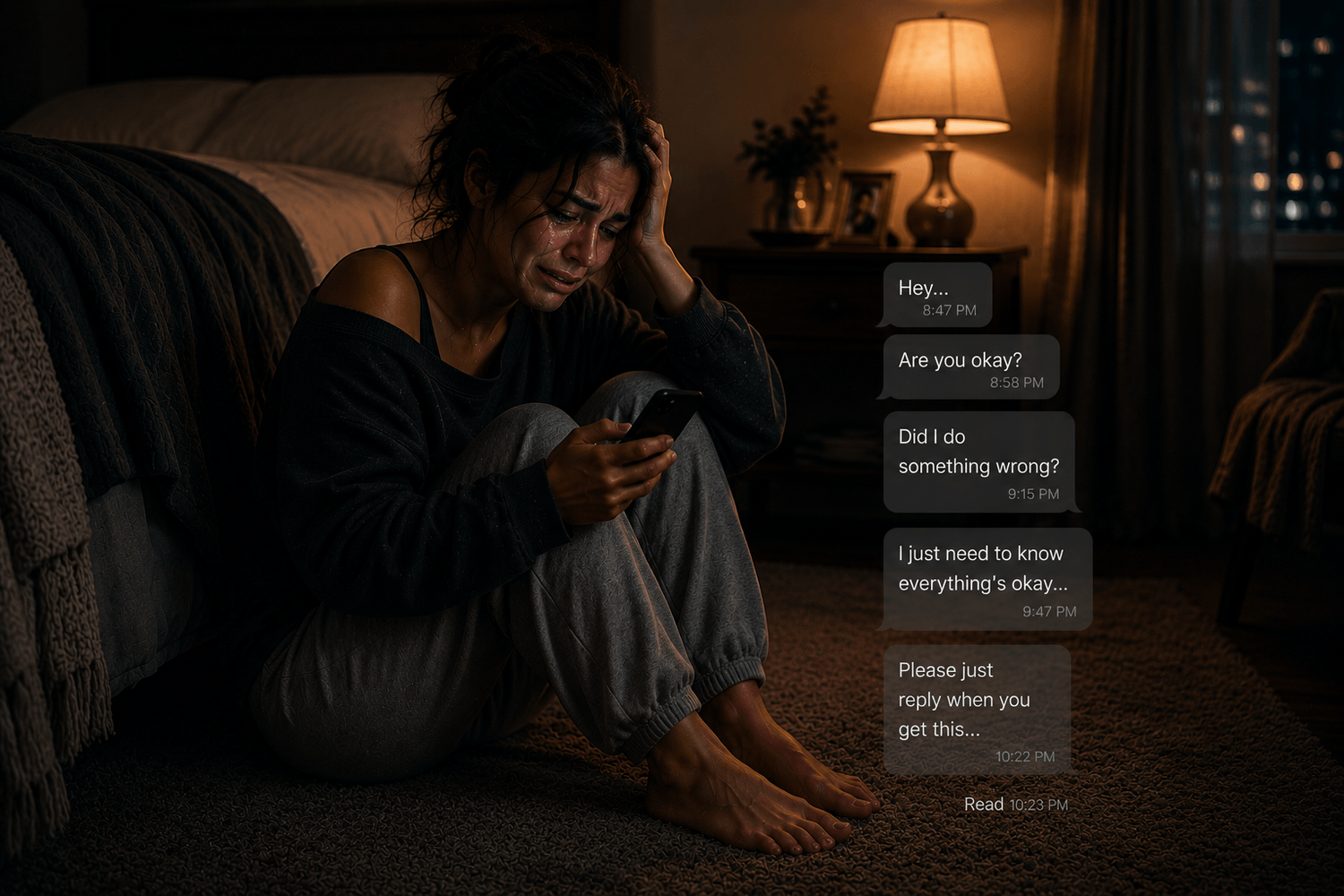
When the internal alarm system's flooded with fear, the mind immediately begins creating a narrative to justify the physical panic. Because the human brain loathes uncertainty, it fills the silence with the darkest possible conclusions.
A short, response becomes definitive proof that they're losing interest. A change in tone means they're angry. A night spent apart becomes the first step toward abandonment. The mind constructs an elaborate, terrifying story of impending loss, and the body responds to that story as if it's an absolute reality happening right now in the room.
The tragedy of this dynamic is that the actions taken to soothe the panic, like the hyper-vigilance, the over-analysis, and the constant bids for connection, often look suffocating to the other person. The partner, feeling overwhelmed by the intensity, pulls back even further to catch their breath. This withdrawal confirms the anxious system's worst fears, accelerating the panic and locking both people into a painful, exhausting loop. One chases out of fear of abandonment; the other flees out of fear of containment.
When the panic remains un-soothed for too long, the anxious system often upgrades its strategy to what's known as protest behaviour. This is a subconscious attempt to force a reaction out of a partner who feels out of reach, using emotional noise to bridge the heart-stopping gap. It's the moment where text messages turn from simple questions into long paragraphs of frustration, or where you find yourself making passive-aggressive remarks just to see if your partner will step up to reassure you.
Sometimes protest behaviour looks like the exact opposite of chasing. You might deliberately ignore their calls, stay silent on purpose, or tell yourself you won't reply to their text for hours just to make them feel the discomfort you've been sitting with.
But this is a painful trap, because even when you try to withhold your affection, your entire focus is still completely locked onto them. You are waiting on the edge of your seat, hoping they notice the silence and move closer to fix it.
It's an exhausting, high-stakes game of emotional chicken where your system is trying to force the partner to prove that the connection still exists.
For someone in this state, time itself becomes a distorted, agonizing metric of love. A simple clock on a wall or a timestamp on a screen transforms into a judge and jury. If a partner usually replies in ten minutes, then twenty minutes feels like a warning sign, and an hour feels like absolute confirmation of a crisis.
You watch the minutes tick by, and with every passing moment, your internal value drops a little lower. The phone becomes a source of physical magnetism, drawing your eyes back to the screen over and over again, even when you know nothing has changed.
This level of hyper-vigilance is completely draining. Your brain is running millions of calculations a second, trying to figure out if you're safe, while the rest of your life, your work, your hobbies, your peace, is put on an indefinite hold until the reassurance lands.

A common frustration for both partners in this dynamic is that reassurance seems to have a shockingly short shelf life. A partner can say, "I love you, everything's fine," and it'll quieten the anxiety for an hour, or maybe a day. But soon enough, the doubt creeps back in, the scanning behavior resumes, and the need for another dose of reassurance returns.
This happens because external reassurance is a temporary bandage on an internal wound. The fear's rooted in an old, deep-seated blueprint that says closeness is fragile, people leave, and safety can be snatched away without warning.
Because the underlying nervous system's still running this outdated software, it can't hold onto the feeling of security. It treats safety like water slipping through fingers. It convinces you that the only way to keep the connection alive is to constantly monitor it, test it, and work for it, believing that the moment you stop managing the relationship is the moment it'll completely fall apart.
Living with chronic relationship anxiety is deeply humiliating. It's a state of being where you're constantly watching yourself act against your own dignity, like sending the text you promised you wouldn't send, over-thinking things until you're physically exhausted, and feeling utterly dependent on someone else's mood just to have a peaceful day. The self-blame that follows can be brutal.
But real clarity only arrives when we stop judging the behavior and start looking at the protection strategy underneath. The heartbeat of healing this pattern shifts the question from "why am I so desperate?" to "what is this terrifying panic trying to keep me safe from?"
The frantic urge to fix, chase, or secure the bond is a brilliant, instinctual survival mechanism. It's an old system trying to protect you from the crushing weight of isolation and rejection. When you realize that your actions are driven by an un-soothed fear rather than a defect in your character, the heavy layers of shame begin to dissolve, and you can finally begin the real work of comforting the panic from the inside out.
We can't point fingers of blame at anyone in this struggle. The behaviors that look like neediness on the outside are actually the evidence of a heart that carries a profound terror of being abandoned. It's a nervous system that learned somewhere along the line that love is unpredictable and that survival requires constant vigilance.
Healing this pattern isn't about shaming yourself into silence or pretending you don't need closeness. It's about learning to recognize the physical surge of panic when it hits, acknowledging it as an old echo of fear, and learning how to anchor your own system before you reach outward. It's a slow, gentle process of building a relationship with your own anxiety, showing your body, one small breath at a time, that you're capable of surviving the discomfort of the space between you, and that your worth's never dependent on a swift reply.
Written by: Jodi ♡ The Attachment Code