
The Wounded Lion
It's incredibly easy to step into a public arena, paint your partner as the unfixable villain, and gather a chorus of strangers to validate your anger. The internet is flooded with these one-sided stories where the avoidant partner is cast as the absolute cause of the wreckage. But a relationship is never a monologue; it's a live broadcast between two distinct nervous systems. When we focus entirely on their withdrawal, we completely avoid looking in the mirror. We ignore how our own attachment reflexes might've forced them into a corner, or how our own panic might've escalated the fire.
The modern obsession with pop-psychology has created a strange illusion that once an insecure attachment label is applied to somebody, these destructive conflict loops become exclusive to them. We treat them like an isolated species of broken humans as though carrying an avoidant or anxious trait somehow separates them from the rest of humanity. The reality is that painful, disorienting conflict happens in every single relationship on this planet, whether romantic, familial, professional, or platonic, regardless of whatever attachment label you claim to have. The vast majority of conflict within all relationships is being directed by the unhealed wounds, historical traumas, and deep-seated insecurities of both parties involved. When a flashpoint occurs, these ancient injuries completely hijack the trajectory of the communication.
When you take your grievances or questions to social media, you'll find that online strangers will gleefully jump into the comments to bash a partner they've never met because they're instantly projecting their own unresolved relationship trauma onto your story. But there's a glaring flaw in this courtroom: the crowd is operating entirely on a half-truth. When people share their relational pain online, they usually only tell their side of the story. They paint a detailed picture of what their partner did, how they withdrew, or what they said to hurt them, while completely leaving out, or relaying just a watered-down version of the part they played in the dynamic.
Those strangers aren't hearing a rounded version of the conflict. They don't know how your own energy, words, or tone heavily influenced the situation, if you aren't telling them. They just immediately latch onto what you've said about your partner because it perfectly matches what they've been through themselves. The irony is that these commentators aren't just ignoring your role in the rupture, they're usually completely blind to the part they played in their own past heartbreaks, too. There's zero objective value in seeking advice from a collective projection where everyone is dodging accountability, rewriting history, and refusing to look at the whole sequence of I said this, they said that.
People will naturally draw from their own narrow perspective, and it's a perspective heavily warped by their personal history. The second someone reads a post that vaguely mirrors their own painful past, their brain flips a switch and assumes that your partner is identical to the person who broke them. They're not looking at your relationship with any kind of objective clarity; they're looking at a mirror of their own unhealed wounds, and they're reacting out of their own lingering bitterness. This is exactly why seeking validation from a crowd of strangers is a dangerous game that delays true healing. Each of those commentators has their own ghosts of the past sitting on their shoulders, dictating their worldview. Their aggressive advice to just run or cut them off directly revolves around their unique experiences, their conditioning, and their familial history. It has absolutely nothing to do with yours. When you take advice from the internet, you're not getting objective wisdom; you're absorbing a collective projection of a thousand other people's unresolved baggage, which only serves to further cloud your judgment and increase your internal panic.
This collective blindness isn't just happening on public forums; it's the exact same mechanism that quietly sabotages our private connections. We don't just project our unresolved history onto strangers' internet stories, we project it onto the person sleeping right next to us. When our early blueprints are left unchallenged, we look at our partner through the exact same distorted lens, treating our current relationship as a battleground for past injuries.
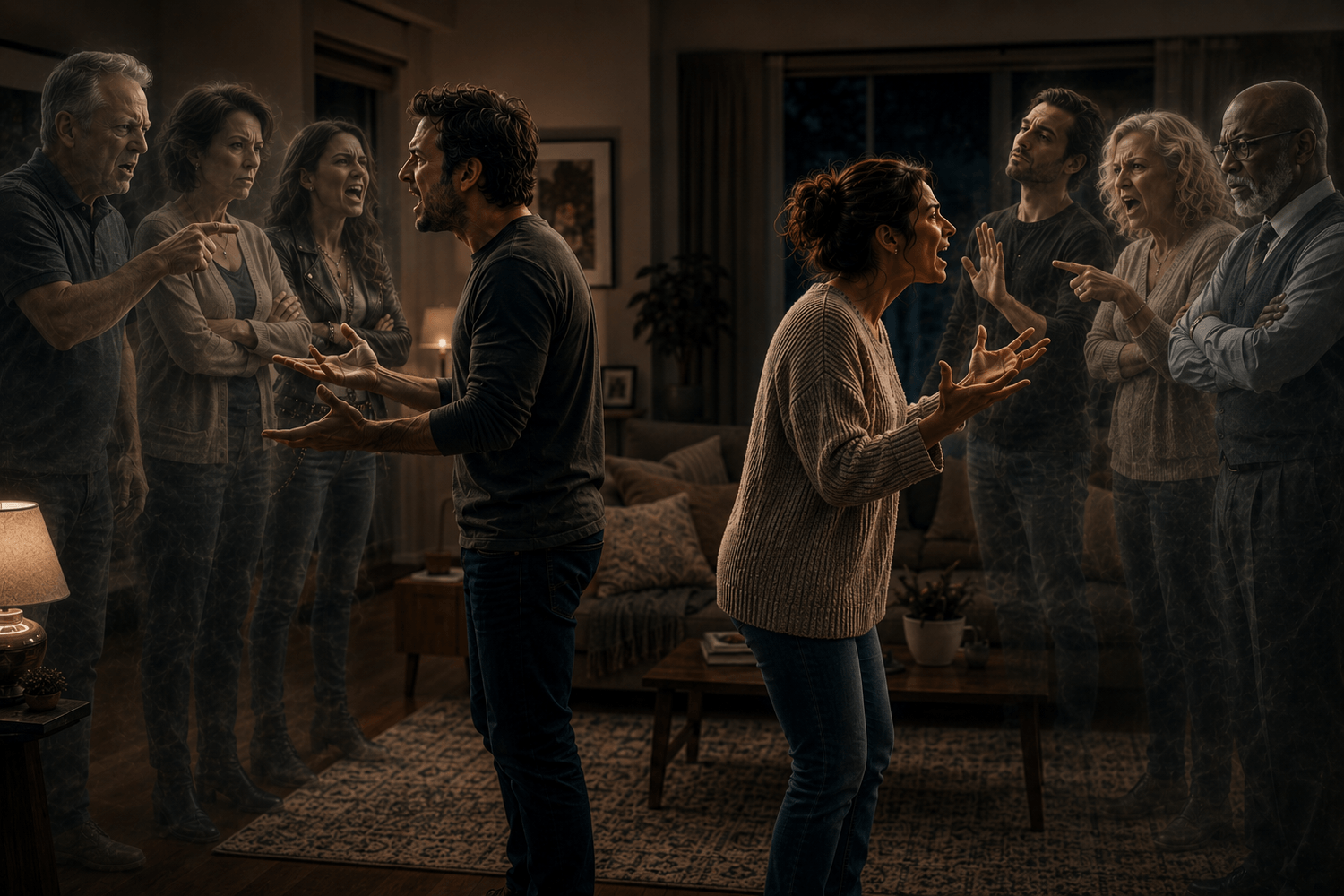
Couples may honestly believe they're arguing about a minor irritation, a forgotten chore, or something trivial that happened that morning, but they're actually fighting an amalgamation of the past. It's never just two adults standing in the room during a clash. Instead, every single person who has ever rejected, betrayed, or hurt either of them shows up to the party. The room suddenly becomes crowded with the ghosts of childhood caretakers, critical ex-partners, and ancient rejections. It devolves into an emotional free-for-all where two reactive nervous systems are screaming at the ghosts in the room rather than speaking to the person standing right in front of them.
When these historical ghosts take over the space between you, the actual topic of the argument completely evaporates. It no longer matters who said what or what the original disagreement was even about, because the conversation has shifted entirely into a battle for emotional survival. One person's nervous system registers a slight shift in tone as total abandonment, while the other person's system registers a request for connection as a claustrophobic ambush. Without realising it, you're no longer attempting to solve a modern relationship issue; you're trying to rewrite a childhood injury in real time, using your partner as a proxy for the people who originally let you down.
This is the hidden anatomy of relational crisis that pop-psychology entirely fails to address. We treat conflict as if it's an intellectual problem to be solved with logic, but logic completely leaves the building the second our physiological defense scripts are activated. When two unhealed blueprints collide in the dark, they trigger each other with mathematical precision. If the behaviour one person uses to protect themselves is the exact behaviour that activates the other's deepest terror, it becomes a closed loop of reactive panic, where both people are convinced they're simply defending themselves, entirely blind to how their defense feels like an assault to the person they love.
Breaking this automated cycle requires a willingness to slow down the momentum of the crash before the damage is done. When you're caught in the grip of a flashpoint, your heart rate spikes, your perspective narrows, and the person you love is temporarily rewritten by your brain as a threat to your survival. It takes immense awareness to recognise that the intensity of your current anger or fear doesn't match the minor irritation that sparked it. Until you can identify the point where the past hijacks the present, you'll continue to view your partner's survival mechanisms as deliberate acts of malice, rather than recognising them as a cry for safety from a system under perceived siege.
The key to breaking this cycle doesn't lie in running away from the friction, but in both parties taking the time to understand how they approach and resolve conflict. The uncomfortable truth is that barely any of us were taught how to navigate disagreement in a healthy, regulated way. This affects every single one of us, without exception. Our modern conflict styles, and very often our core attachment styles, are heavily determined by the relationship dynamics we witnessed as we were growing up. More often than not, children simply absorb the conflict habits of their parents, inheriting a relational blueprint that they carry straight into adulthood. Unless we actively choose to do the deep work required to heal, we're doomed to repeat those exact generational cycles.
For someone raised in a volatile environment, even the most minor irritation or trivial disagreement can instantly result in them blowing up and threatening to end the entire relationship. To an outside observer or a casual internet forum, that looks like calculated, toxic behaviour. But in reality, that extreme reaction is simply the only script their nervous system knows, because that's the exact chaotic volatility they witnessed everyday during their childhood. When your early conditioning teaches you that conflict equals total destruction, your survival reflex will always tell you to burn the bridge before you get burned. It's a preemptive strike designed to protect the self from an impending collapse that their history tells them is inevitable.

True accountability has nothing to do with tolerating bad behaviour, nor does it mean you swallow your own boundaries to keep a fragile peace. It's about recognizing that as long as you focus entirely on their flaws, you're handing them the remote control to your emotional state. The entire premise of healing is to bring you completely back to yourself and to take back your power, no matter where you fall on the attachment spectrum. When you operate from an anxious attachment style, you're actively giving your power away to the person who's causing you anxiety, allowing their stability to dictate your own. When you operate from an avoidant style and treat your loved one as a phantom partner, you're handing your power over to the ghosts of your past. The people who hurt you years ago are allowed to live rent-free in your head, controlling your current relationship, your future happiness, and your choice of who to love.
It's a bitter pill to swallow, but until you take ownership of your triggers, you're simply a co-author of the chaos. They're running a survival loop, but so are you, and until you actively interrupt that momentum, your behaviour is entirely predetermined by what happened to you years ago. You believe you're reacting to what's happening right in front of you, but you're actually projecting an ancient betrayal onto a modern moment, and you might be completely oblivious to the weight of that impact on their side of the fence. When you fight fire with fire, the result can only ever be more fire!
Think of how this plays out in the real world. You can step toward your partner with pure love, completely convinced that you're offering peace, while their internal system is experiencing a total ambush. You might reach out to give them a hug, to say that conflict is pointless and all you need to do is talk it out, only to watch them react like a trapped, wounded lion. A lion is normally proud and magnificent, but when it's injured, its head drops, it fiercely guards its wounds, and it retreats into a state of dramatic, defensive rage. In that split second, they may be acting like a scared animal. They may literally tell you they feel cornered and trapped, even when there's no part of you trying to cage them. Your loving step forward collides directly with their survival loop, and because you can't relate to that intense panic, you're left completely disoriented.
This reaction can feel like a profound rejection, tempting you to strike back or retreat into your own defensive fortress. When the proud lion roars out of pain, it takes an extraordinary amount of emotional maturity to look past the sharp teeth and see the hidden wound beneath the armour. If you meet that defensive rage with your own activated panic, you validate their internal script that closeness is dangerous and that you are indeed the enemy. The entire dynamic becomes a tragic miscommunication where two people who desperately love each other are driven further apart by the very defenses meant to keep them safe.
When a partner retreats into that defensive, lion-like state, our automatic instinct is to force our way into their cave to demand answers or offer immediate fixes. We treat their withdrawal or their roaring deflection as a problem that needs to be solved right this second. But when a proud system is guarding a deep, historical injury, any uninvited intrusion, even one wrapped in the language of love, feels like an absolute assault. Learning to navigate a relationship with a wounded lion means understanding that their temporary exile isn't a declaration of war against you; it's their automated, frantic attempt to regain equilibrium.
If you meet their defensive walls with your own reactive panic, you simply confirm the ancient script inside their head that closeness equals danger. The breakthrough happens when you learn how to give the lion its perimeter without abandoning your own grounding. It's about developing the capacity to stand steady on the outside of the cave, sending a quiet signal of safety rather than trying to smoke them out. When you shift the atmosphere from an adversarial courtroom to a space of calm, predictable presence, you starve their survival loop of its oxygen, and their defensive armour can finally begin to drop.
The most liberating truth about these destructive relational cycles is that they're built entirely on learned behaviour. None of us were born with an immutable, lifelong diagnosis that condemns us to a lifetime of relationship wreckage. The chaotic blueprints we witnessed in childhood and the automated scripts we execute in adulthood are simply highly practiced survival strategies. And the beauty of any behaviour that has been learned is that it can absolutely be unlearned and consciously relearned. It takes a tremendous amount of courage to put down the generational weapons you inherited, but the moment you are willing to look at the sequence of your own interactions with genuine curiosity, the cycle loses its permanence.
This isn't about looking for a quick fix or a magical cure that erases your history overnight. It's about recognizing that with the right willingness to do your own inner work, those automated survival reflexes can be intercepted before they cause total destruction. You can learn to catch the spike in your nervous system, recognize the ancient ghost trying to speak through your mouth, and make a completely different choice in real time. When you commit to doing that deep, personal excavation, you stop participating in a repetitive loop of past traumas and finally create the space for a conscious partnership built on the reality of the present.
Human intimacy is a messy, high-stakes endeavour where two distinct histories are constantly trying to find a common language in the dark. Turning our partners into disposable commodities the second their historical wounds show up doesn't create a society of healthy, independent adults; it creates a lonely landscape of isolated fortresses.
We don't have to settle for a lifetime of navigating unexploded minefields, nor do we have to discard every good person who struggles with the heavy architecture of their past. True healing lives in the middle ground, far away from the simplistic advice to run. It belongs to the couples who have the courage to name the ghosts in the room, the vulnerability to admit when their internal system is crashing, and the shared commitment to put down the weapons of yesterday so they can finally choose the truth of today.
Written by: Jodi ♡ The Attachment Code